For warehouse managers, these scenarios must sound familiar: incoming goods with nowhere to store, insufficient space for forklift turning, and sky-high costs for warehouse expansion.
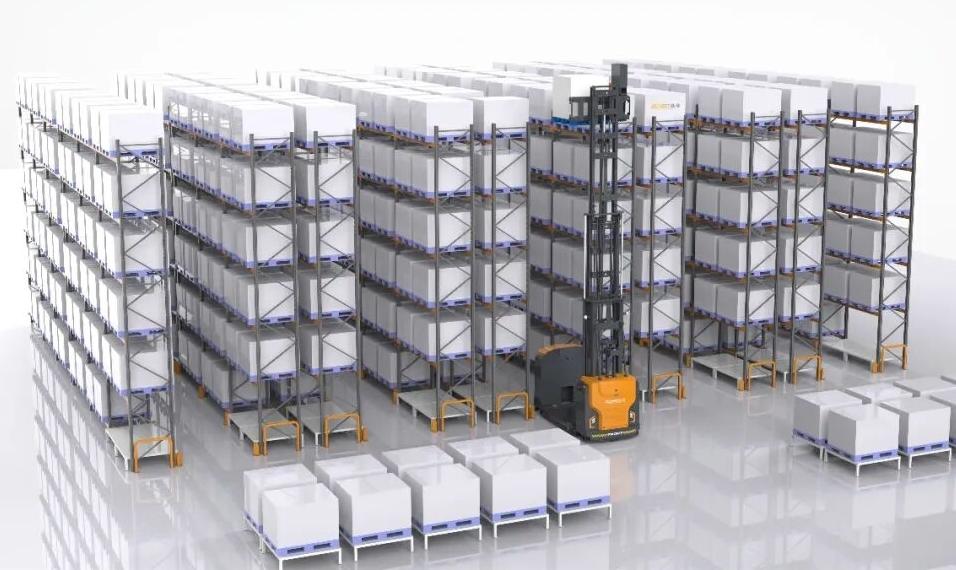
When it comes to 7–11 metre high racking operations, a segment that thoroughly tests equipment performance, traditional reach trucks hit obvious bottlenecks. They normally require a working aisle of 2.7–3.5 metres, leading to inherently low storage density. Their efficiency drops sharply at higher lifting heights. Even warehouses with ample floor area waste most space on aisles instead of value-generating storage locations. FOBOT ADV Omni-directional Narrow Aisle AMR redefines the old mindset that “warehouse capacity depends on floor space”.
What is a reach truck? A reach truck features an extendable mast. Its sliding mast and forks stretch forward to pick up goods; after loading, the mast retracts to keep the load centre within the vehicle support points for stable travel.
Working aisle width: 2.7–3.2 m
Max lifting height: ~12 m
Typical load capacity: 1–2 t
Typical space utilisation: 50–60%
Advantages of reach trucks
Mature technology & accessible procurement: Decades of development, complete industrial chain, wide range of domestic and imported models with controllable purchase cost.
Low learning curve: Experienced forklift operators can master operation within 1–2 days.
Good floor adaptability: Works on standard epoxy flooring without special ground modification.
Its mechanical structure sets a hard limit. Restricted by turning radius, the aisle can hardly be narrower than 2.5 metres. Those extra centimetres mean the loss of an entire row of racks. Steering agility is limited, mostly with single steering wheel design. Labour dependency remains a major pain point: manual operation requires shift rotation. Businesses face labour shortages, rising labour costs and safety risks caused by operator fatigue.
Reach trucks were a great solution for their era. Yet they struggle to meet today’s demands for higher storage capacity and growing labour expenses.
A reach truck moves its mast. FOBOT ADV moves the whole vehicle.
Core strength: Narrower aisles, more racks
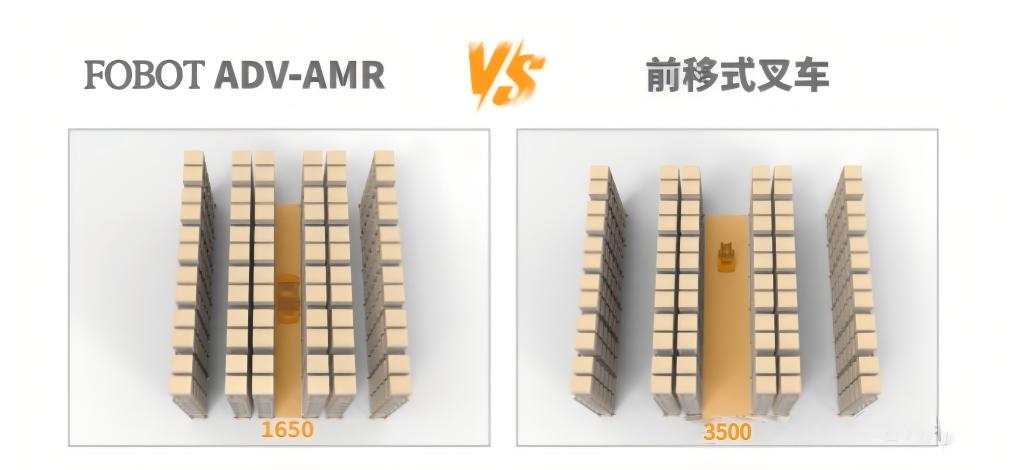
Traditional reach trucks need large turning space, requiring aisles of 2.8–3.5 metres. It is like a house where corridors take up half the space, leaving little room for rooms.
Powered by dual steering wheel omni-directional chassis technology, FOBOT ADV supports 360° in-place rotation and lateral translation. No sharp turns are needed at aisle ends, and cross-aisle transfer can be completed within 3.6 m.
FOBOT ADV only requires an aisle width of 1.65–1.8 m, cutting aisle space by roughly 50%. In a 43 m wide warehouse area, traditional reach trucks can fit 14 rack rows, while ADV can accommodate 20, lifting storage capacity by 30–40% — equivalent to adding six extra rows of racks.
Narrower aisles alone are not enough. FOBOT ADV reaches up to 11 metres, covering 5–11m medium & high racking scenarios and unlocking unused high-level storage locations.
Traditional reach trucks suffer from stability loss above 9 metres. Equipped with high-position anti-tilt design and millimetre-level positioning accuracy, ADV maintains stable operation at 11m height without load dropping or tipping. Wasted vertical space becomes valuable storage.
Compared with traditional reach trucks, FOBOT ADV delivers up to 200% faster loading & unloading. Two key benefits: combined movement of mast lifting and fork rotation to shorten each pick & place cycle; omni-directional movement eliminates complicated turning. Its throughput reaches 120–150% of manual operation. One unit handles raw material inbound and high-level stacking.
As warehouse land costs keep rising, the old model of expanding floor space to gain storage capacity is no longer viable. With ultra-narrow aisle design, high lifting capability and omni-directional mobility, FOBOT ADV helps enterprises boost storage density within existing premises.
Expand capacity, not warehouse. That is the value FOBOT ADV brings to the logistics industry.
You may wonder: are reach trucks obsolete? Definitely not. Reach trucks still have suitable applications. The key is clarifying your actual operational requirements.
| When to Choose a Reach Truck | When to Choose the ADV AMR |
|---|---|
| • You already have aisles 2.8 m or wider | ✓ You want to maximize warehouse storage capacity |
| • Limited budget — cost-effectiveness is the priority | • Aisles are narrow, or you plan to narrow them |
| • Operation is primarily manned / human-driven | ✓ You aim for unmanned operation and automation |
| • High lifting height required (7 m+) | ✓ You need 7×24 continuous operation |
| • Warehouse layout is fixed with no major redesign planned | ✓ You value long-term ROI and a future-proof layout |